

 LinkedIn
You can buy a click in Google Ads. You cannot buy your way into a ChatGPT answer the same way. Yet business owners who know paid search often approach AI citations with the same three habits: buy the position, target the keyword, measure the click. Each habit points them toward the wrong work.
I understand the instinct. In Google Ads, if a search term drove revenue, you bid on it. If the landing page converted, you put more budget behind it, expanded coverage, and checked the search terms report for junk. Search looked like an inventory problem: find the high-intent shelf space, pay the toll, get the visitor.
ChatGPT and Perplexity do something different. When they use web sources to answer a buyer’s question, they need passages they can extract, understand, and place alongside other evidence. A landing page can win a paid click while giving an answer engine almost nothing useful to quote. Here are five beliefs I would retire before spending money on AI visibility.
Belief 1: ‘If it matters, I can buy it’
Paid search taught us that budget could bypass the organic queue. Launch a new B2B product, bid on high-intent terms, and your ad could appear before your category page had any chance of ranking. It is tempting to expect the same arrangement when a buyer asks Perplexity for the best warehouse inventory software: find the ad tier, pay for the mention, move on.
An ad beside an answer is not a citation inside it. Perplexity phased out its sponsored follow-up questions experiment. Paid placements and the sources used to construct an answer are different things. Even where a platform offers advertising, buying the placement does not make your product a factual source the assistant can use in its response. The distinction between ads and answer citations matters more than the sales deck makes it sound.
The cost of this belief is not just a wasted ad inquiry. It is the work you postpone while waiting for a self-serve dashboard that solves the citation problem for you. As Google’s changing citation playbook shows, this is not a channel where you can assume one familiar placement will stay put. Make your business easy to describe accurately in an answer, and make those descriptions checkable beyond your own site. Do not wait for an insertion order to do the job.
Belief 2: ‘Pick the keyword, write the page’
A tidy Google Ads account can reward tight alignment. Pick a phrase such as “commercial refrigeration maintenance,” write an ad around it, and send the click to a relevant landing page. That habit makes a list of 300 keyword variations and 300 corresponding pages feel like a plan for AI search.
But a buyer’s prompt is often a problem, not a phrase. Consider: “We are a 45-person legal firm in Illinois looking for practice management software that integrates with NetDocuments, handles trust accounting, and doesn’t require an outside consultant to implement. What are our top three options?” A page built around “best legal practice management software” may repeat the category name perfectly and still fail to answer the question.
The useful unit is the answerable passage, not the keyword-stuffed URL. AI search can retrieve passages from pages. If the relevant integration details and implementation limits sit below two screens of testimonials and generic slogans, a clearer technical document or independent discussion gives the engine more to work with. That is the mechanism behind the miss: your page may be relevant to the category but unhelpful on the buyer’s constraints.

Research on how ChatGPT selects sources finds that 44% of citations come from the first third of a webpage and reports a 7x citation lift for question-based headings on smaller domains. Those figures are not a promise that moving a paragraph will win a citation. They are a good reason to stop hiding the answer.
There is another limit to the keyword-page reflex: ChatGPT does not trigger live web search for every query. Publishing a page is not the same as putting it in every answer. When retrieval does happen, clear, information-dense passages have a better shot than keyword volume alone. Instead of fifty shallow pages for slight variations of a phrase, write blocks that state the relevant constraints, pricing bands, and compatibilities under headings a buyer would recognize. Put the direct answer first.
Belief 3: ‘More pages means more coverage’
Once you have accepted “pick the keyword, write the page,” the next mistake follows naturally: publish more pages. In paid search, expanding ad groups and match types can reach more demand. Traditional SEO has its own version: thirty shallow posts a month to cover every long-tail variation on a spreadsheet. Fifty answers to nearly the same buyer question can look like fifty chances to be cited.
More URLs can mean more maintenance, not more useful coverage. A pile of thin, overlapping articles gives a retrieval system little that a well-kept reference page could not explain more clearly. It also gives your team fifty places to leave a price, integration, or limitation out of date. The finding that recently updated content earns more ChatGPT citations points toward an operational choice: keep substantive answers current rather than publishing variants you cannot maintain.
I would rather have one reference document that plainly covers benchmarks, pricing tiers, and diagnostic steps than forty articles that circle the same question without resolving it. This is not an argument against publishing new pages. It is an argument against mistaking page count for answer quality. Before creating another URL, ask what distinct buyer constraint it answers and whether the existing page could answer it better.
Belief 4: ‘My own site is the whole story’
In Google Ads, the landing page is a controlled room. You pay for the visit, choose the headlines, remove distractions, and aim for the conversion. It is easy to carry that sense of control into AI search: if your own site says the product is fast, reliable, and easy to implement, why wouldn’t an assistant repeat it?
Because a vendor claim is stronger when other sources support it. Answer engines can draw on independent sources when assessing claims. For vendor comparisons, reviews, forums, and industry publications can enter the answer alongside product pages. Your landing page can explain what you offer. It cannot, by itself, establish what everyone else has experienced with it.

That makes the cost of this belief concrete. Spend $15,000 polishing product pages while your directory profiles and relevant industry discussions sit neglected, and the assistant may have a much less flattering picture than your homepage does. If independent discussions describe a six-month onboarding process while your site promises instant setup, a buyer asking about implementation may encounter that conflict in the answer.
Do not try to solve an off-site evidence problem with another homepage rewrite. Keep your own claims specific, check how the business appears in the sources buyers and answer engines encounter, and address real gaps there. You need a credible account of your product across the wider web, not a louder version of it on your own domain.
Belief 5: ‘If I don’t see clicks, it didn’t work’
A Google Ads dashboard starts with the paid session. Someone clicks, lands on your page, and, if the tracking holds together, moves toward a conversion you can measure. It is tempting to judge AI answers by the same event: no referral click, no result.
An answer can shape a shortlist without sending a visit. Buyers can read a comparison in the prompt window, note the names, and carry on. SparkToro’s 2026 study found that 68.01% of US Google searches ended without an external click. That figure is about Google searches, not a direct measure of ChatGPT or Perplexity, but it illustrates why a click-only view can miss what happens before a site visit.
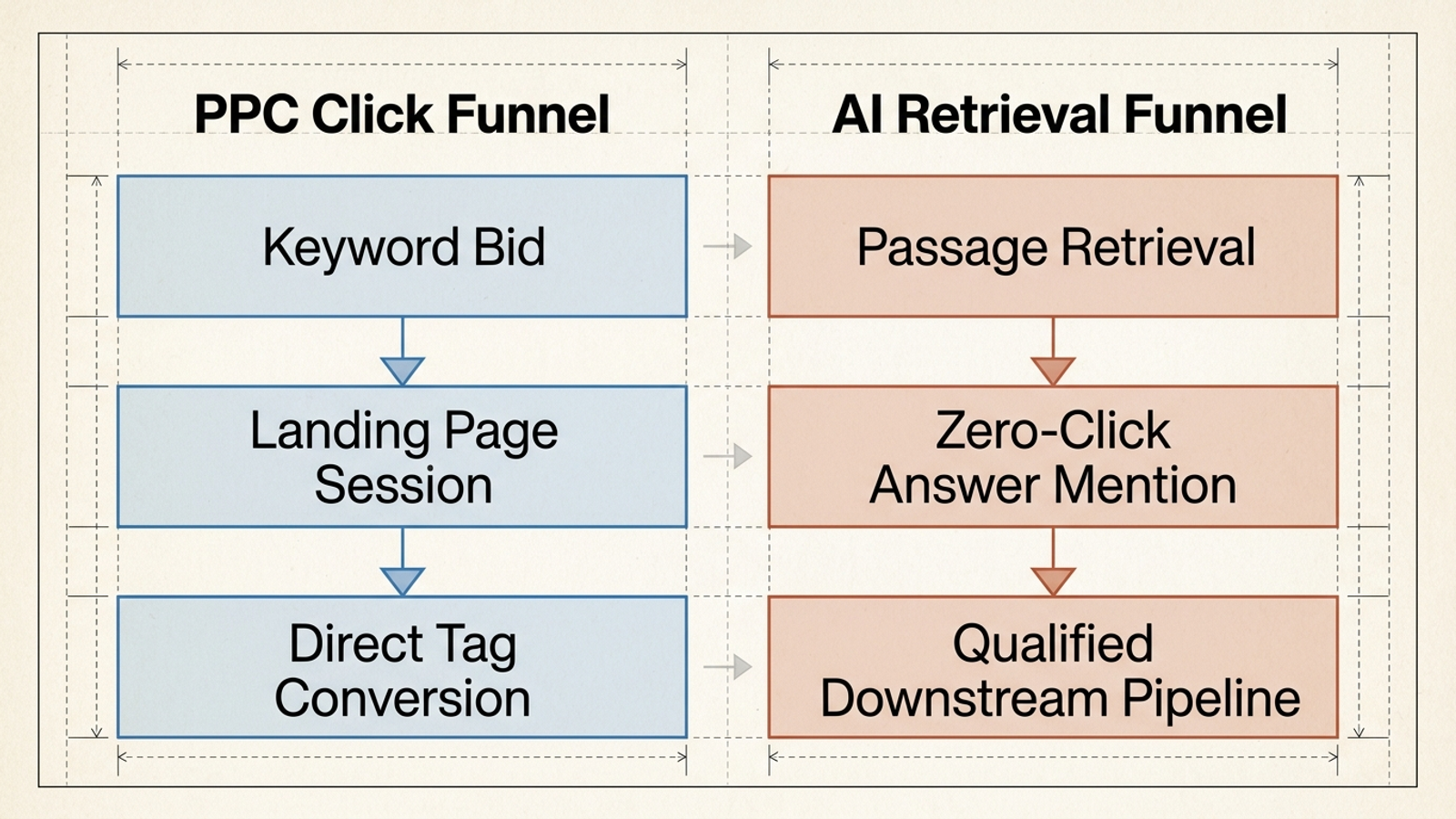
There is also a distinction between a mention and a link. AI brand mentions do not always carry clickable citations. An assistant can name a product in a recommendation without sending the buyer through a citation pill. GA4 referral sessions will show some of the traffic that follows an answer. They will not show every time your business appears in one.
That does not mean counting every mention as a sale. Small volumes can produce seductive conversion stories; practitioners discussing AI referral traffic report strong downstream performance, but a few high-intent visits should not replace a measurement plan. Build a repeatable view of AI search visibility rather than trusting one screenshot: track whether you are named, whether you are cited, and whether qualified inbound interest changes alongside those appearances. Keep clicks. Stop treating them as the whole scorecard.
What does transfer from PPC
None of this requires throwing out your paid-search instincts. The useful part of PPC was never just bidding. It was reading what buyers actually asked, testing changes against a baseline, and correcting problems before they drained the budget. Those disciplines still work. Their objects change.
Query mining becomes prompt mining
The best part of a search terms report was seeing what real people typed, not admiring the keyword list you planned in a spreadsheet. For AI search, look at the compound questions buyers ask. A prompt such as “What warehouse management software integrates natively with NetSuite and doesn’t require a six-figure implementation partner?” gives you more direction than a broad category term.
Use the buyer’s constraints to shape the answer. Turn a recurring question into a clear heading. Under it, state the relevant integration and implementation facts directly. If you cannot substantiate a detail, do not bury that gap under a longer introduction. The prompt tells you what the buyer needs to know; your job is to make the answer easy to find.
Control groups still beat case studies
I do not trust a before-and-after screenshot without a baseline. If an agency rewrites ten posts and claims the new voice generated a Perplexity citation, the first question is what happened on comparable pages that did not change.
Run a modest holdout: take ten mid-tier product or service pages, rewrite five into structured answer blocks with relevant third-party references, and leave five untouched. Track the same buyer prompts and citation rates over thirty days. The test will not settle every cause-and-effect question, but it gives you more to work with than a single flattering response. At groas, paid and organic work sits in the same operating model, with changes and their reasoning logged rather than left to a monthly slide deck. Keep a record of what changed before claiming to know why visibility moved.
Continuous execution replaces weekly check-ins
Leave a Google Ads account unattended and waste can accumulate in search terms, bids, and budgets. AI visibility needs attention too: answers and their cited sources can change, so last month’s screenshot is not this week’s position.
That does not mean a human should spend all day manually checking prompts while an agency bills for the privilege. The work calls for continuous monitoring and execution within clear guardrails, with a named strategist responsible for direction and accountability. Automate the repeatable checks; keep a human responsible for the decisions.
The first three things to change this month
If you have spent years relying on Google Ads, start with the habits you can change now. This is the checklist I would run on Monday morning:
- Put the answer where it can be found. On primary product pages, bring qualification criteria, pricing parameters, and system compatibilities forward. Place a direct, self-contained answer under a heading that matches a real buyer question.
- Check the sources beyond your site. Test ten buyer prompts in Perplexity and record where its cited information comes from. If reviews, specialist discussions, or trade publications shape the answers, inspect what they say before paying for another product-page redesign.
- Measure appearances as well as visits. Set a baseline of twenty high-intent prompts. Track mentions and citations week over week, then compare those movements with branded search and qualified inbound pipeline. Do not call a missing GA4 referral the end of the story.
The belief I am still not sure about is one that sits beneath the whole argument: answer engines will keep organic answers separate from paid influence indefinitely. Today, treating a paid placement as a way to purchase an organic recommendation is a mistake. But anyone who has watched search advertising evolve should be cautious about calling the current boundary permanent. Infrastructure costs and revenue pressure give platforms reasons to revisit their models, even if paid weighting would put trust in the answer at risk.
If that day arrives, paid-search veterans will recognize the auction. Until then, treating ChatGPT and Perplexity like ad networks is a fast way to spend money without becoming a useful source. Give an answer engine facts it can extract, check, and place in context. Or watch a competitor do that work while you wait for the bid button.