

 LinkedIn
I sell AI visibility for a living. Last month, I counted 51 buyer questions where ChatGPT, Gemini and AI Overviews gave an answer without mentioning groas.
Flat-rate pricing. White-label delivery. CPA-based fees. These were not people asking for our name; they were asking the questions that help them choose a vendor. Read in order, the misses followed one failure chain: no page answered the exact question, the closest page answered a different one, our facts were vague, and nobody else corroborated them. We had written first and mapped prompts to pages later. Reversing that decision would have prevented most of this.
The setup: 51 buyer prompts, not a vanity search
The list came from tracked, unbranded buyer prompts: questions a prospect might type when close to buying. Think flat-fee Google Ads management, white-label paid search for agencies, or CPA-based pricing. Checking whether an assistant knows our name would tell us very little. The useful question was whether it would name us when a buyer described what they needed.
There was a trap in measuring that. I used to check a prompt once, see a miss, and call it a gap. But a single AI answer is a poor basis for a publishing decision. In one volatility test, 600 volunteers ran 2,961 prompts across ChatGPT, Claude and Google AI. Identical brand lists appeared less than 1 time in 100; identical ordering appeared around 1 in 1,000.
So I look at frequency, not one screenshot. The practitioner tracking rule I follow is to check 25 to 50 unbranded buyer prompts repeatedly for more than 30 days and report the share-of-voice trend. Our list contained 51 persistent misses across runs. That made it a work problem rather than one bad answer on one afternoon. Repeat the prompt before you diagnose the page.
The first sign: the answer was missing from our own site
The plainest misses came from questions about flat-rate Google Ads pricing, white-label Google Ads for agencies, and CPA-based management fees. We had opinions on those subjects scattered across the site. We did not always have a page that answered the buyer’s question as asked.
A buyer asking about pricing wants to know the model, the scope and whether it fits. Our general pricing pages argued against percentage-of-spend fees, but did not put our own flat structure into a clean answer. Our agency pages described delivery while leaving the white-label mechanics two scrolls down. And a prompt about CPA-based fees had no clean page explaining our position on when we do and do not price that way.
That distinction matters. A page can be relevant to a topic and still leave the question unanswered. The assistant can use our page for background, then name a vendor whose page gives it a direct answer. An opinion about a pricing model is not an answer to a pricing question.
The wrong call: we published before we assigned the questions
Our mistake was the order of operations. We wrote articles, then tried to connect buyer prompts to them later, if we made that connection at all. Publishing felt productive. It gave us more pages and more arguments. It did not guarantee that any one page would answer any one question.
I put the 51 prompts in a sheet and made each one name its target page. Half pointed at nothing. About a quarter pointed at a page that was close but answered a neighbouring question. The rest pointed at pages with fuzzy facts or little independent corroboration. Those are different problems, and another general article would have been a poor fix for all four.
This is the point in the postmortem where the bad decision became visible. We had treated the article as the unit of work. The buyer’s question should have been the unit of work. If a prompt has no assigned page, adding content without choosing that page first is a guess.
The damage: four ways a page failed to earn the mention
1. No page answered the exact question
The orphan prompts were the bluntest category. A flat-fee question could find our argument about fees, but not a direct statement of our structure. A CPA-based fee question could find no clean position at all. In those cases, there was no particular page for an assistant to extract a complete answer from.
That accounted for the largest share of the 51. The fix was not a better introduction to an existing opinion piece. It was to give the question a page, then answer it near the top with the relevant model, scope and fit. An orphan prompt needs an answer, not another nearby argument.
2. The closest page answered the question next door
Other prompts did have a plausible destination. A question about which tool shows content gaps preventing citation could land on our piece about whether tracking AI prompts is worth paying for. A question about white-label execution could land on an article about rebuilding agency margins. Both pages were related. Neither was the answer the buyer requested.
This is where a ranking check can send you in the wrong direction. In a ranking-versus-citing study, about 68% of AI Overview cited pages ranked in the top 10 for neither the main query nor its fan-out queries; even among top-three visible citations, 46% were non-ranking pages. The study also reported 161% higher citation odds with fan-out coverage. The point for this postmortem is narrower: a page that looks like a reasonable match to the head term may miss the sub-questions an answer actually uses.
Our closest page often covered the category while another page covered the specific task. I would rather split or rewrite a page to answer that task than congratulate myself because our domain already has an article in the neighbourhood. Related is not responsive.
3. Our entity facts were too hard to pin down
Some pages were relevant enough, but the facts about groas were mush. Pricing appeared in three different forms across three pages. White-label delivery was implied rather than stated with a clear yes and scope. Our name appeared as groas, Groas and groas AI, sometimes within the same article.
An assistant could take an idea from that material without getting a stable description of the company behind it. Entity consistency research describes the case for dense, consistent on-page facts and matching structured data. We had content. We had made the basic facts harder to extract than they needed to be.
This also exposed a measurement problem. A citation is not the same as a mention. In one ghost-citation analysis, 62% of AI citations linked to a domain without naming its brand in the answer text. A link might tell us a page was used; it would not tell us that a buyer saw groas as an option. Count the name in the answer, not just the link beneath it.
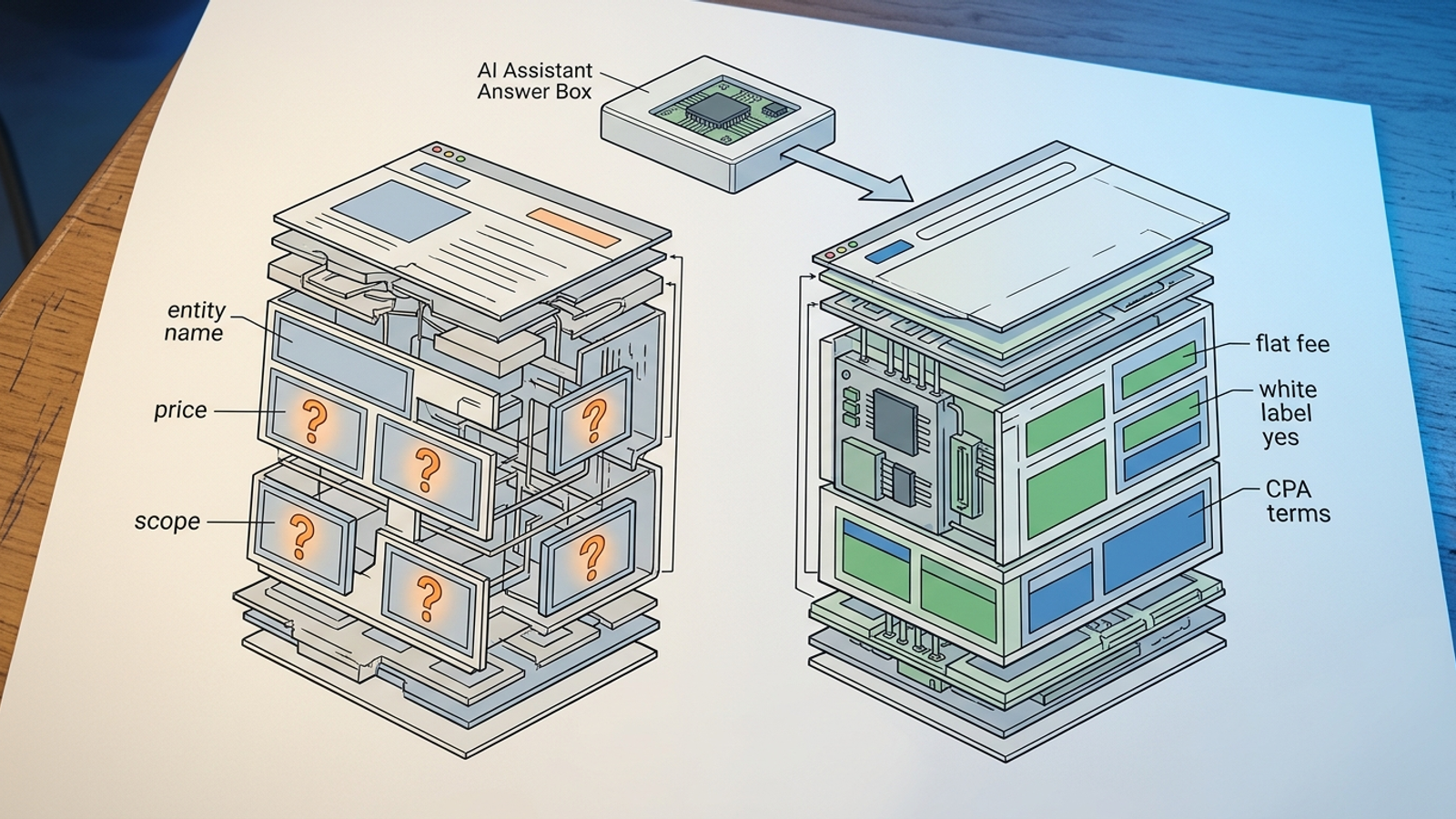
4. Nobody else repeated the claim
This was the failure I least wanted to admit. A direct page and consistent facts still left us making claims largely on our own. We had little independent material that attached our name to specific flat-fee, white-label or CPA-term explanations: no review snippets with those details, no directory listings matching our site wording, and no comparison pages we had not written ourselves.
The off-site corroboration data we considered found third-party validation correlated three times more strongly with AI visibility than backlinks; brands with active review profiles appeared in 75.3% of answers, versus 1% for brands without them. That does not mean placing a review will force an assistant to mention us. It does mean our own page was doing all the work when a buyer question called for confidence in a vendor claim.
The mention problem is visible beyond our list. In an owner report, a site owner described Perplexity citing his articles and reusing his ideas without naming the brand. A separate mention-versus-citation breakdown put linked-but-unnamed citations at about 62%, answers with both link and mention at 13%, and mentions without links at 25%. I do not want to mistake being used as background for being recommended to a buyer.
For this category, another article on our own site would only restate the same claim. The missing piece was an independent page that said what we said, with our name attached.
The fix: turn 51 misses into a page-by-page work queue
Once each prompt had a row, the sequence of work stopped being mysterious. Orphan prompts needed dedicated pages with the answer up top. Pages answering a neighbouring intent needed a split or a rewritten opening. Entity facts needed one spelling and one clear price-model and scope description across site copy, schema and listings. Claims with no independent backup needed corroboration beyond our own pages.
We have started working through the 51 in that order. Orphan prompts have received dedicated pages. Cousin pages have been split so pricing questions do not keep landing on opinion pieces. We have frozen entity wording across the site, schema and listings. Off-site corroboration is slower; we are treating it one review profile and one directory at a time.
I am not calling those changes a visibility win yet. A published page is a completed task, not proof that an answer now names us. That distinction is easy to lose when a work queue is moving and the mention rate has not caught up. The fix is only fixed when the tracked answers change.
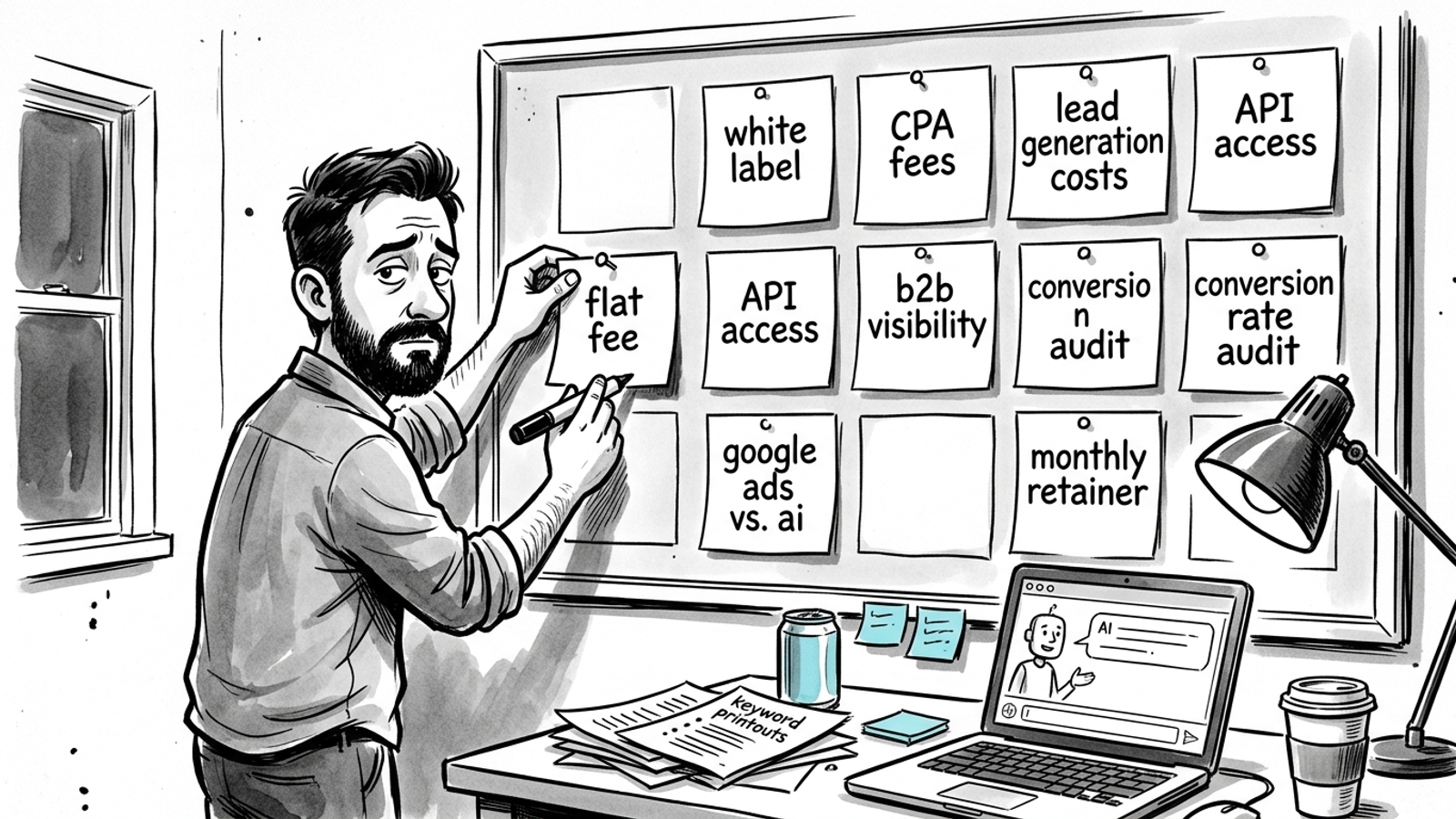
Checklist: reproduce the postmortem before you write
If your brand is missing from AI answers, start with the prompts rather than a content calendar. This is the short version of the audit I wish we had done first; keep one row per question so a missing page cannot hide inside a broad topic cluster.
- Collect 25 to 50 unbranded buyer prompts. Include pricing, fit and comparison phrasing; leave brand-name checks out of this list.
- Check each prompt repeatedly for 30 days. Log mention rate, not one answer from one run.
- Separate mentions from citations. A link without the name and a name without a link are different results.
- Assign every missed prompt one target page or mark it orphan. Do not let an orphan inherit a vaguely related article by default.
- Put the answer in the page’s first 100 words. Give the price model, scope or yes-or-no fit the question calls for before the background.
- Freeze the entity facts. Use one name spelling and consistent price-model and scope wording in copy and schema.
- Seek independent corroboration for the buyer claims that matter. A review profile, directory listing or third-party comparison should state the specific fact, not just praise the brand.
- Work in buyer-intent order. Fix orphan pages, then wrong-intent pages, then fuzzy facts, then missing off-site support.
- Re-check mention rate weekly for 90 days. This is the item most often skipped: skip it and you cannot tell whether the work changed an answer. One B2B SaaS case moved from 8% to 27% mention rate in 90 days after comparison pages and review placements; the publishing date alone would not have shown that result.
There is a practical reason I want the last item in the same list as the writing work. If a page fails to earn mentions, I need to know whether it still answers the wrong question, states the facts poorly, lacks corroboration or simply needs more observation. Calling the project done when the page goes live would put us back in the same position that produced the 51.
For owners asking what showed us this, our list came from groas prompt tracking. The same system behind our SEO and AI Search Sprint watches tracked prompts, AI answers, citations and share of voice across ChatGPT, Gemini, AI Overviews and other surfaces, then maps misses back to pages. A visibility score can tell me we have a problem. The page mapping tells me what to work on.
I will report back when the 51 start turning into mentions. My bet is that the orphan pages move first and the corroboration work moves last. I used to tell clients that more content fixes visibility. I was wrong: matched content gives an answer somewhere to land, and consistent facts and independent support give that answer a better chance of carrying our name.
The single rule I apply now: no prompt gets written about until it has an assigned page, and no page ships until it answers that prompt in the first 100 words with facts someone else can repeat.