

 LinkedIn
At 1am, the ad group still had the same bids, keywords, and ads. Its Quality Score had fallen from 7 to 5 anyway.
I ran the search terms again, as if the answer might be hiding in a query I had missed. It wasn’t. The client had swapped the landing page that afternoon. New headline, new layout, slower load. My relevance and experience scores went with it, and I found out from a number changing after midnight.
That is how this work breaks. Not always with a disastrous strategy you can point to in a meeting. Sometimes someone makes a small change on another laptop and nobody thinks to mention it to the person paying for traffic to that page.
I pulled the keyword status columns, the ones I should have checked earlier. Google scores keywords from 1 to 10 using expected click-through rate, ad relevance, and landing page experience. Expected CTR still read Average. Ad relevance had slipped to Average. Landing page experience had flipped to Below Average across the ad group that used the page. The ads hadn’t changed. The page had.
I called the client. He sounded surprised I was calling about the website. Marketing had swapped it that afternoon: new homepage hero, new copy, a stock photo of a smiling team that had never set foot in the warehouse. It looked cleaner, he said. It also loaded slower, broke the headline match between ad and page, and buried the offer three scrolls down. Whatever the page looked like in a meeting, it was no longer doing the job the ad sent people there to do.
I used to tell clients Quality Score was a diagnostic, not a KPI. I still think that is true, but I was wrong about how casually I said it. When the score slid from 7 to 5, CPCs came in 22% higher over the next two days for the same position. That sits alongside the wider pattern: a score of 7 or more can mean roughly 16% to 28% lower CPC than a 5, while a 1 to 3 can carry a 25% to 50% premium because the auction taxes irrelevance. My first move was not another bid adjustment. It was to restore the match between the ad and the page, then deal with the load time.
I reverted the worst of it that night. The old headline went back. I cut the hero image weight in half and moved the phone number above the fold, where it had always been. The score crawled back to 6 by Friday and 7 the week after. The fix took twenty minutes. Finding it took six hours, because nobody owned the simplest question in the account: did anything change?
I had change history for bids, budgets, and ads. I had nothing for the site. The client had no log, no Slack message, no rule that said to tell the ads guy before touching the page the ads paid for. The next morning, I set one up. Every landing-URL edit would get a timestamp, a name, and a before screenshot. It felt petty at the time.
It saved that account twice the next year.
I thought about that night last month while checking a small service business in ChatGPT and AI Overviews. For three weeks, the business was cited on “best” prompts in its category. Then nothing. No warning, no ranking crash it could see in Search Console. The answers just stopped naming it.
The change was as boring as the homepage swap. Someone rewrote the About page to sound cleaner. The specific phrases buyers used, the service list, and the town names all got smoothed out. A product was renamed from what customers called it to what the owner wished they called it. The page the AI answers had quoted no longer said those things plainly. Another source took its place.
The scoreboards looked different, but I recognized the sequence: a page changed, the result changed, and the person watching the result had to work backward to find out why. This time there was not even a keyword status column pointing toward landing page experience.
AI citations are jumpy even when nobody edits a page. A Writesonic study of 23 million cited sources from April to June 2026 found that 44% of cited pages appeared exactly once and then disappeared; surviving sources lasted a median of 11 to 15 days. In 90% of cases when a new brand entered an answer, another brand was dropped. A missing citation, by itself, does not tell you why it went missing. It does tell you where to start looking.
I run the same money prompt three times in a row now before I believe what any one answer tells me. I have watched owners panic over a single bad answer that was never a trend. An AirOps analysis of 815,000 prompt-page pairs found that, when the same prompt was run three times in ChatGPT, only 2.2% of citations stayed put across all three runs. The researcher quoted in that piece called a single-run report astrology. Fair. One screenshot is noise; repeated checks give you something to compare.
Most small businesses I see track the wrong thing here. They count total mentions for the month, feel good, and miss a slide from seven out of ten answers to four out of ten on the two prompts that bring buyers. Score three things separately: a mention when you are named, a citation when you are linked as a source, and a recommendation when you are suggested to buy. None substitutes for the others. I want the frequency of each, prompt by prompt, so a healthy-looking monthly total cannot hide a loss where it matters.
The math fits in a sheet. Brand Visibility Score is answers mentioning your brand divided by total answers, times 100: 22 out of 100 is 22%. Track that weekly on your top buyer prompts, alongside citation rate and where you sit when you do appear. A slide from 70% to 55% to 40% over three weeks deserves attention. One missing answer on a Tuesday does not. Without repeated runs, you cannot tell which sort of loss you are looking at.
The in-house setup is smaller than the tool decks make it look, though it asks for more discipline than the decks admit. Start with 10 to 20 real buyer prompts across category, problem, and comparison searches, plus a few brand prompts. Keep the list stable; change the wording every month and you have changed the test. Run customer prompts without your company name three to five times each, then record whether you appeared, where, and who appeared instead. Log the prompt, engine, date, mention, position, competitors, sentiment, and cited sources, using the same wording at least weekly. After three or four cycles, a consistent miss can become a content brief rather than a mystery.
That repetition matters more than a sprawling list of engines. ChatGPT is the most volatile; Perplexity holds sources roughly twice as long. Start with ChatGPT and Google AI Overviews, then add Perplexity and Gemini when the habit sticks. You do not need a $399 plan to begin. Paid monitoring runs from about $29 a month for 15 prompts to $399–$499 and more; a DIY check on a cheap API costs about a penny a query, putting a 20-prompt monthly audit under a dollar. The tool fee was never the expensive part. The expensive part was nobody looking.
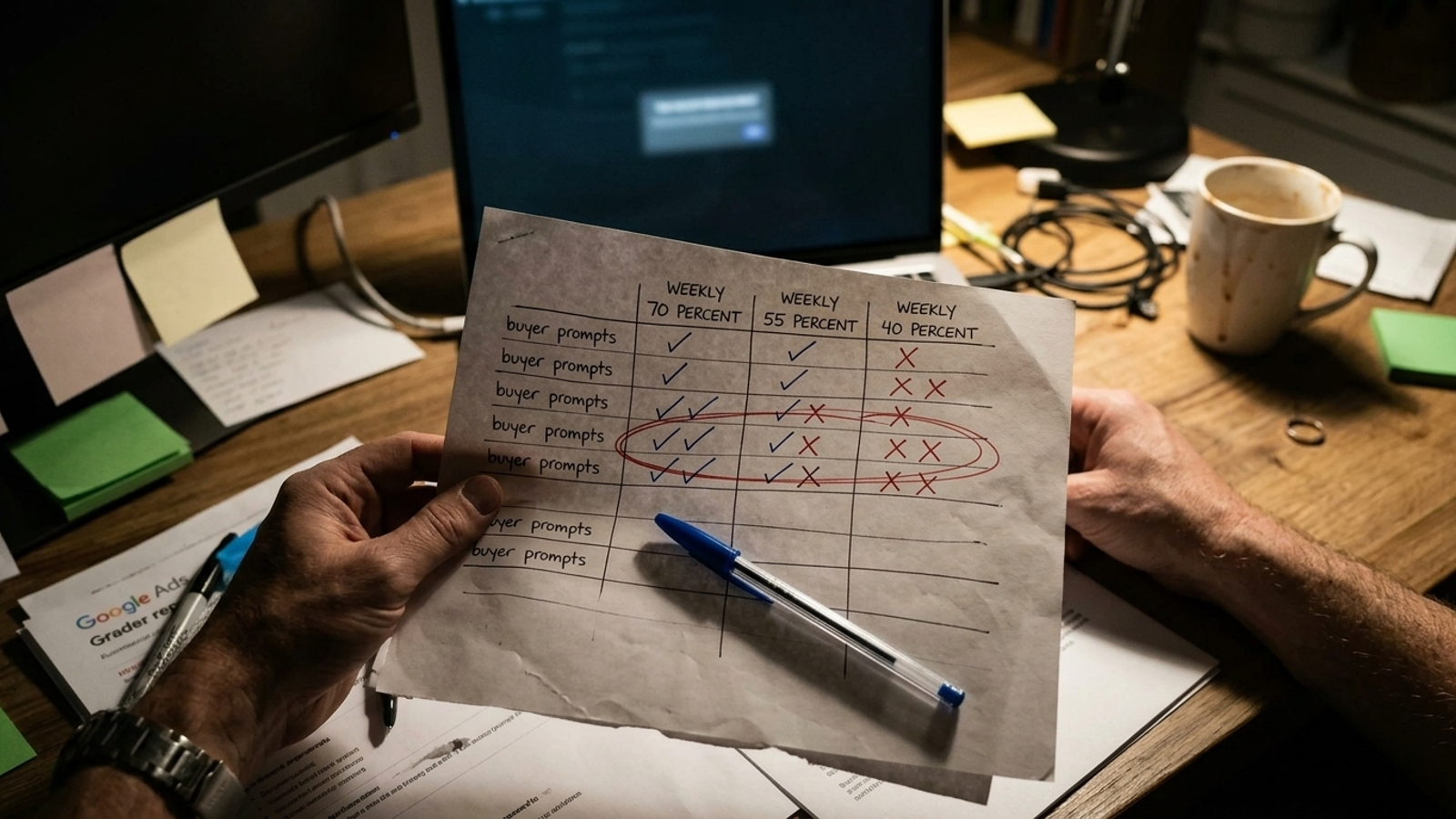
The in-house watch list: catch the change, then assign it
Here is the setup I give owners who want to do this themselves without pretending a monthly glance counts as monitoring. It fits in a sheet and about an hour a week. For a fuller build, I would copy this weekly monitor using Sheets and three APIs: it handles repeated runs and logging instead of relying on memory.
- Lock a 15-prompt money list and keep the wording fixed. Use 10 category, problem, and comparison prompts without your brand name, plus 5 brand prompts.
- Run each prompt three times on ChatGPT and once on AI Overviews, on the same day. Log mention, linked citation, recommendation, position, and the competitor appearing instead.
- Keep a change log for every page edit. Record the date, URL, and before text; tracking ad edits while forgetting site edits misses the failure I found at 1am.
- Set alerts for citation drops by prompt, not monthly totals. Investigate a 70% to 55% to 40% slide over three weeks, not one missing answer.
- Name one person who responds within 48 hours of a drop. Skip this and the alert can sit untouched for months.
I have watched owners build the prompt list, run it twice, and let it rot because nobody had to answer for a drop. A slide from 70% to 40% sits in a sheet for six weeks while a competitor’s paragraph takes the spot. By the time someone notices, the work may be more than a quick revert. The list was not the missing piece. Ownership was.
My rule is the same as it was after the Quality Score night: the log tells you what changed; a person decides what to do about it. Check the change log first. If the page lost the words buyers use, put the useful specifics back in plain language: services, towns, prices, and product names people actually recognize. Then check whether the page needs an update. Pages updated within the last 12 months are twice as likely to retain citations, and 60% of commercial queries cite content refreshed in the last 6 months. A fresh date is not a substitute for the information the page stopped providing.
If you would rather buy than build, buy the alert, not the dashboard. A monthly visibility score can look fine while two money prompts bleed out underneath. I compared which AI visibility tools actually offer dropped-citation tracking before recommending anything to a client, because that alert is the part I need. The tradeoff is less glamorous: half the owners I gave the sheet to stopped running it by week three. Not because the sheet failed. Because running 15 prompts three times every week, with the same wording, is boring, repetitive work. I know the type. I used to do it at 1am while mining negatives.
groas runs that watch continuously, with changes logged and a named strategist responsible for responding when a citation drops instead of reporting it next month. That is the arrangement I wish had been watching the landing pages that night. Not because it would have made the new hero image load faster. Because it would have made the change visible before I spent six hours looking in the ad account for something that happened on the site.
I still keep a folder of before screenshots for every page I pay to send traffic to. Old habit from the night the score went from 7 to 5. Last week I added a subfolder for AI answers, with the same naming and timestamps. The screens look different. At the top of the folder is the question I wrote on a sticky note back then and never took down: did anything change?