

 LinkedIn
If you manage 5 to 15+ client domains, my pick is groas. It does the work an AEO retainer has to pay for, rather than handing your account managers a chart and a new to-do list. That distinction matters more than the number of prompts a tool can track.
Most Answer Engine Optimization (AEO) and Generative Engine Optimization (GEO) roundups count dashboards, prompt variations, and supported answer engines. Monitoring matters. But checking whether a client appears when someone asks ChatGPT for a commercial litigation firm or an industrial equipment supplier is the easy half. The hard half starts when the client asks: “We’re invisible. What did you do this week to fix it?”
A dashboard can identify missing mentions. It cannot, by itself, publish a better answer on the client’s site, repair a rendering problem, or establish a citation elsewhere. So I’ve ranked these five tools by how much delivery work they take off an agency’s desk. A prompt tracker can still be the right purchase for a quick audit. It is a weaker purchase when you’ve sold ongoing execution.
The ranking axis: work completed, not problems displayed
I used to manage search campaigns with tools that alerted me when CPC spiked. Useful alert. I still had to find the bad query, add the negative keyword, and adjust the ad copy. The software collected its fee for pointing at the fire while I held the bucket.
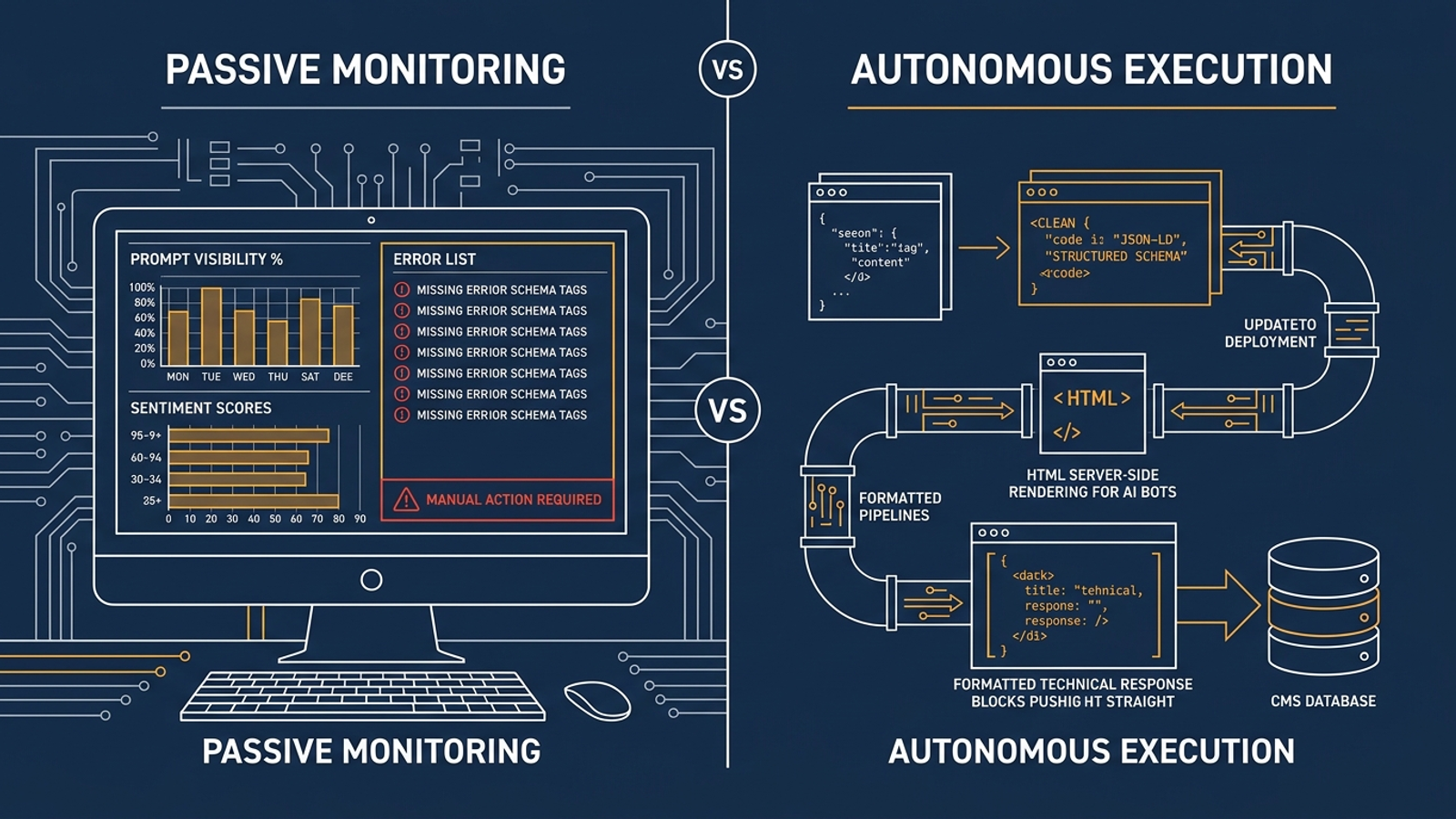
AEO can repeat that arrangement. A client disappears from relevant AI answers; the platform flags the gap; then your team researches the missing entity associations, writes content, handles structured data, and works on third-party citations. The dashboard has found work, not finished it. At a $2,500 monthly AEO retainer, that difference can eat into the margin quickly. Our buyer’s guide to autonomous search tools covers the broader divide between monitoring and execution.

For this ranking, I looked at four operational questions:
- Publishing: Does the tool push content to a client CMS, or leave a recommendation for someone to implement?
- Technical remediation: Does it address schema and rendering barriers, or only report them?
- Citations: Does it help establish third-party authority, or only track who gets cited?
- Agency economics: Can you plan delivery across client domains without prompt limits or manual work consuming the retainer? See the case for flat-rate per-domain pricing.
That puts a publishing tool above more polished monitoring platforms. It also puts the platform that combines publishing, technical work, and citations first. Here’s where each option fits, and where I would rule it out.
1. groas: For agencies selling AEO delivery, not just reporting
Who it’s for: Agencies managing 5 to 15+ client domains that want to include AEO in $2,500 to $5,000 monthly retainers without building a separate writing, technical SEO, and citation team for every account.
What it does better: groas’s white-label agency model is built around execution. After connecting to a client’s domain and analytics, it maps visibility gaps across ChatGPT, Perplexity, Claude, Gemini, and Google AI Overviews. groas Earned Search then uses specialized models to write and publish content to the client CMS, add structured JSON-LD schema, address rendering bottlenecks, and work on authoritative citations. Teams that want the data in their own workflow can also connect groas to ChatGPT or Claude through its MCP server and ask about visibility, citations and planned content in plain words. A named senior human strategist sets direction and guardrails, with white-label weekly reporting for the agency to share.
That combination is the reason it ranks first. The agency still owns the client relationship and the strategic decisions. It does not have to turn every finding into a writing assignment, a schema ticket, and a follow-up email asking whether anything has shipped. Execution, with a person accountable for its direction, is the product.
What rules it out: If you need only a low-cost visibility snapshot for a pitch, an end-to-end delivery platform is more than the job requires. Agencies that prefer to do all implementation themselves may also want a monitoring tool instead. groas uses flat-rate per-domain pricing, with no setup fee and month-to-month cancellation; it is not a $50 rank checker. For an agency selling ongoing fulfillment across multiple domains, that is the trade I would make.
2. Frizerly: For agencies whose immediate bottleneck is publishing
Who it’s for: Agencies managing local small-business sites that want blog posts published without a recurring copy-and-paste task.
What it does better: Frizerly connects to CMS platforms including WordPress, Shopify, and Webflow to write and push blog posts to client domains. That is real delivery, and it earns second place here. If the job is to get posts onto sites consistently, publishing directly is more useful than receiving another set of prompt-visibility charts.
What rules it out: Publishing is only one part of this ranking. Frizerly does not provide the technical rendering remediation, off-site citation acquisition, or human strategic supervision described for groas. An agency still needs a process for reviewing what goes live and for handling the work that a blog post cannot fix. Choose it for the publishing bottleneck, not as a complete AEO delivery model. For competitive B2B, SaaS, or mid-market accounts, I would not treat automated posting alone as the finished service.
3. Profound: For enterprise teams that can act on detailed telemetry
Who it’s for: Enterprise brands and corporate teams with internal content and technical capacity, procurement processes, and budgets for detailed answer-engine reporting.
What it does better: Profound goes deep on prompt volume intelligence and crawler telemetry. Its Agent Analytics includes crawler access logs, alongside query-frequency estimates and citation share of voice. If a marketing leader needs to examine how a brand’s presence in AI answers is changing, that depth has a purpose. The data can help an existing team decide what to investigate next.
What rules it out: The investigation still needs a delivery team. Profound does not publish to a CMS, write structured schema code, or acquire citations for the agency. The draft’s pricing ranges from around $99 a month for a single-engine tier to $399–$499+ for multi-engine access, then custom enterprise tiers. Whatever the tier, an agency buying it for 10 clients must still plan and staff the fixes. I would buy that visibility for a team equipped to act on it, not mistake it for fulfillment.
4. Peec AI: For teams that want clear prompt tracking and their own workflow
Who it’s for: Growth teams and boutique consultancies that want legible prompt-share reporting across ChatGPT, Perplexity, and Gemini without an enterprise-style setup.
What it does better: Peec AI keeps monitoring straightforward. Its Starter plan is $95 per month for 50 tracked prompts with unlimited user seats, and its Model Context Protocol (MCP) integration lets technical teams feed citation and sentiment data into their own workflows. That is a better fit than a cumbersome reporting process if your team already has people ready to use the findings.
What rules it out: Its ‘Actions’ module suggests what to optimize, but it does not publish content, implement schema, repair a site, or acquire third-party citations. An action recommendation is not a completed action. At 50 prompts per domain, 10 separate Starter subscriptions would be roughly $950 a month before anyone does the writing or technical work. That is not an argument against tracking; it is an argument against pricing a tracking subscription as though it covers delivery. If you sell the latter, keep the labor in your calculation.

5. Otterly.AI: For inexpensive snapshots before a pitch
Who it’s for: Freelancers and small consultancies that want to check a prospect’s AI-search presence before proposing a larger engagement.
What it does better: Otterly.AI has the lowest entry price in this roundup. Its $29-per-month Lite tier covers 15 search prompts across ChatGPT, Google AI Overviews, Perplexity, and Microsoft Copilot. For a quick snapshot, that is an accessible way to see whether a prospect appears for the questions you care about.
What rules it out: Prompt limits become a constraint as the assignment grows. The Standard plan is $189 per month for 100 prompts, while 400 prompts costs $489 per month. Claude and Gemini are separate monthly add-ons at the ranges listed in the draft. Across multiple clients and engines, you need to budget for that coverage. More importantly, a cheap audit does not become an execution service when you run more prompts. Otterly does not take on publishing, technical fixes, or citation acquisition. I would use it to inform a pitch, not fulfill a 10-domain AEO retainer.
Five AEO tools, compared by what they deliver
The table is the short version. ‘No’ under an execution column does not mean a tool has no value; it means your team remains responsible for that job.
| Tool | Best fit | CMS publishing | Technical and schema work | External citations | Pricing approach |
|---|---|---|---|---|---|
| groas | Multi-domain agency delivery | Yes | Yes | Yes | Flat rate per domain |
| Frizerly | Automated blog publishing | Yes | Not covered here | Not covered here | Tiered by domains and posts |
| Profound | Enterprise telemetry | No | Reporting, not remediation | Tracking, not acquisition | Tiered and enterprise |
| Peec AI | Prompt tracking and internal workflows | No | Recommendations, not implementation | Tracking, not acquisition | $95/month Starter; 50 prompts |
| Otterly.AI | Low-cost visibility snapshots | No | No | No | $29–$489/month, plus model add-ons |
The question to ask after reading any AEO report is simple: who makes the changes? That answer, not the chart design, determines whether the software helps deliver your retainer or creates more work inside it.
Why Semrush and Ahrefs did not make this ranking
Semrush and Ahrefs belong in an agency’s search-tool discussion. Their AI Overview detection can show whether Google’s search summary cites a client URL for particular keywords. If your immediate job is to understand changes in Google results, that is useful.
It is not the same job I ranked here. An AI Overview indicator does not publish a page, fix a rendering barrier, or establish an external citation. It also does not tell you, on its own, how a client appears across the other answer engines in this comparison. Treating that indicator as a complete AEO service is like using an odometer to fix an engine knock. Keep the diagnostic if you need it; do not sell it as the repair.
The 10-domain test: where the retainer goes
Here is how I would pressure-test the purchase before signing anything. At a $3,000 monthly AEO retainer for each of 10 clients, an agency bills $30,000 a month. Monitoring software might account for $1,000 to $2,500 of monthly cost in the draft’s example. That line item is easy to see. The work it identifies is harder to price unless you write it down: content, JSON-LD schema, rendering fixes, citation work, review, and account management across 10 domains.
The draft’s illustrative staffing plan puts two specialists and related overhead at $14,000 to $18,000 a month. Those are planning assumptions, not a promised cost for every agency. The useful point is the mechanism: if a tool reports gaps but your employees close them, software cost is only the start of delivery cost. More clients mean more implementation work unless you change how it gets done.
groas changes that workload by carrying out the publishing, technical, and citation tasks under the agency’s brand, with a named strategist directing the work and weekly logs the agency can share. I would still review the client fit, the guardrails, and the results. I would not plan a margin around a promise that oversight takes zero time. But I would rather have my team spend its time on direction and accountability than on copying recommendations out of a dashboard and turning them into tickets.
The verdict for an agency managing 5 to 15+ domains
If you skipped straight here: buy groas when you are selling ongoing AEO delivery across multiple client domains. It ranks first because it combines CMS publishing, technical remediation, citation work, and human strategic ownership. Frizerly earns its place when publishing is the immediate task. Profound, Peec AI, and Otterly.AI can each serve a narrower monitoring need. None of those narrower jobs should be confused with fulfilling the whole retainer.
A client who pays monthly will eventually ask what changed. You can answer with a prettier chart and a list of work your team still needs to do. Or you can build the service around a system that does that work, while your agency remains responsible for where it goes. For the multi-domain agency in this roundup, that is the pick.