

 LinkedIn
The question behind the dashboard
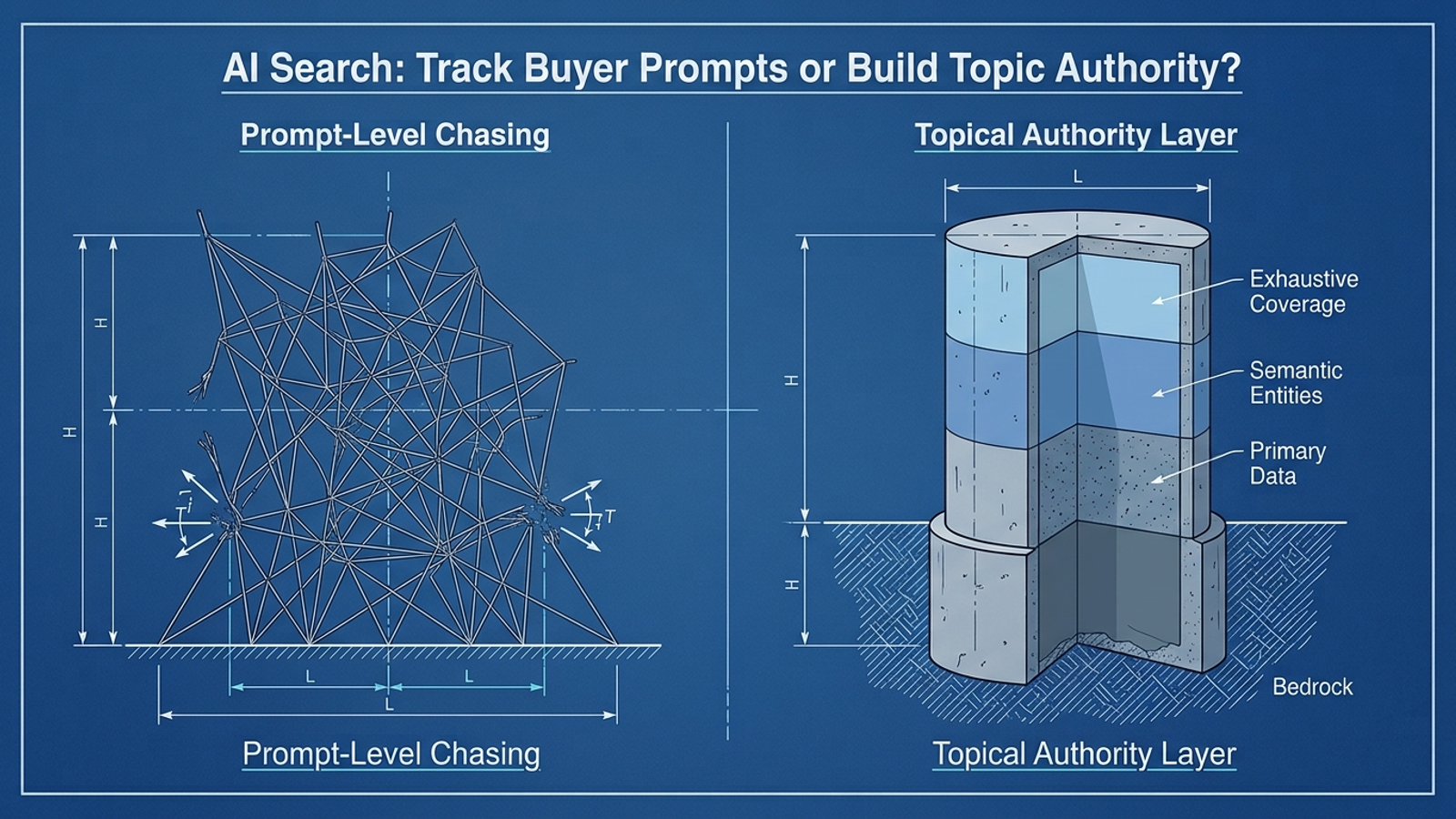
Should you track the buyer prompts where AI engines mention you, or build the topics that make you worth mentioning? Smart search operators disagree because both sides can point to a real failure. A brand can publish excellent material and never appear when a buyer asks for a recommendation. It can also spend months watching a prompt dashboard flicker without changing what an engine knows about the business. I think prompt tracking is keyword-level thinking applied to a non-deterministic system. That makes it useful as a diagnostic and a poor substitute for the work: building topical authority.
The prompt-first operator loads hundreds of buyer questions into a tracker and watches mentions across ChatGPT, Google Gemini, and Google AI Overviews. The topic-first operator cancels the tracker and puts the budget into comprehensive coverage, clear entity relationships, and primary data. One sees a measurement problem. The other sees a knowledge problem. Each has a stronger case than the other camp likes to admit.
Side A: Track the prompts buyers actually ask
I understand the prompt-first instinct. For years, good search management meant looking past a broad theme to the query that exposed a buyer’s intent. In paid search, you inspect search terms, cut irrelevant traffic with negatives, and align ads and landing pages with what the buyer wants. A buyer prompt looks like the next, richer version of that search term. Ignoring it can feel like running an account without opening the search terms report.
A buying scenario is more revealing than a keyword
Buyers evaluating B2B software, commercial equipment, or professional services do not have to squeeze their needs into two or three words. They can ask, “What is the best contract management platform for a 50-person legal team migrating from Ironclad?” or “Compare commercial refrigeration repair companies in North Jersey with 24/7 emergency dispatch.” Those questions expose constraints, alternatives, and purchase intent in one place.
For Side A, a missing mention on a question like that is not an abstract dip in visibility. The engine just named competitors to someone describing a plausible purchase. You need to know which questions produce that answer before you can investigate why. Start with the buyer’s question, not a generic visibility score.
A prompt set makes the gap visible
Without observed prompts, AEO can become an exercise in telling leadership to publish more content and hoping the numbers improve. Prompt advocates want a scorecard tied to the questions buyers ask, especially unbranded ones. Testing by Radyant and Peec AI found that branded prompts generated a 99.7% mention rate, while unbranded category prompts generated brand mentions in only 13.3% of responses. A brand-only dashboard could make a business look impossible to miss while buyers asking about the category barely encounter it.
I have spent enough time in search terms reports to respect this argument. Broad themes can hide expensive misses. Side A’s best claim is not that every prompt deserves its own page; it is that you cannot diagnose a commercial visibility gap you refuse to observe.
The PPC habit has a point, even here
When broad matching sends paid-search traffic toward irrelevant queries, operators inspect the terms and correct course. Prompt advocates bring that same discipline to AI answers: collect representative buyer questions, see which brands appear, and investigate the omissions. Conversational answers may be fluid, but a buyer still receives a concrete answer at the moment they ask.
That is the strongest version of Side A. It does not require pretending a prompt is a traditional keyword. It requires taking a lost recommendation seriously enough to record it. If you never check buyer questions, you leave the buyer-facing result unexamined.
Side B: Stop chasing strings; build the topic
Side B’s objection starts with the machinery. A traditional search result and a generated answer do not behave alike. AI engines can synthesize responses from retrieval and broader semantic associations rather than return one fixed brand list for one fixed string. A tracked prompt is a sample of an answer, not a ranking you own. Treat it as a permanent position and the dashboard starts telling a much tidier story than the system warrants.

The same question can produce a different list
SparkToro and Gumshoe.ai analyzed 2,961 runs across buyer prompts in ChatGPT, Claude, and Google AI. Their study found that ChatGPT and Google AI had less than a 1 in 100 chance of returning the same recommended brands twice across identical runs, and roughly a 1 in 1,000 chance of returning them in the same order. That is a serious problem for anyone selling a move from second to fifth place on one prompt as evidence of lost ground.
The topic-first operator asks a blunt question: what would you change because of that alert? If the answer is “rewrite a page to match this prompt exactly,” you may be reacting to sampling variance. One answer is a clue, not a verdict.
Buyer phrasing outruns any tracker
A buyer can add seat counts, an existing stack, legacy constraints, and compliance requirements to the same basic question. Another buyer describes the problem without using the category name at all. As seoClarity argues in its AEO workflow analysis, curating and optimizing for individual strings becomes a treadmill when phrasing expands faster than a tracking spreadsheet.
A separate thin page for every variation creates clutter. A substantial resource that explains the underlying problem, implementation constraints, and relevant comparisons can address many variations at once. For Side B, coverage compounds; prompt-matching pages multiply. The work belongs in the topic, not in an endless queue of near-duplicate questions.
The recurring players matter more than their order
A benchmark by Detailed analyzing 800 generative search responses found that 86% of responses within a category drew from the same core cluster of recognized industry players even as exact brand lists shifted. Its analysis also reported an average of 8.5 brands and 20.6 URLs per response. Side B reads that as a reason to become part of the recognized cluster instead of obsessing over your position in one generated list.
That means building material an engine can use to understand the business and the subject around it. As BLKDG’s analysis of answer engine optimization notes, answer engines draw on underlying search indices, which makes structured information and verifiable primary sources more valuable than a page engineered around one prompt. Make the whole topic legible before you try to win a sentence.
Where each argument breaks
Side A’s weakness is the dashboard trap. Prompt monitoring can consume the budget and attention needed to fix the underlying footprint. Some dedicated tools charge upwards of $2 to $3 per tracked prompt each month, while the underlying raw model API call costs approximately $0.0015. The software may offer more than the call itself, but a chart of volatile positions is not an execution plan. Worse, one engine is not a stand-in for every other engine: an analysis of 100,000 prompts by Whitehat SEO found that 89% of citations differed between ChatGPT and Perplexity. Tune everything to one ChatGPT phrasing and you may learn little about your presence elsewhere. Measurement cannot do the repair work.
Side B’s weakness is the accountability vacuum. “Build authority” can become a pleasant-sounding way to avoid checking whether buyers see any result. I have heard enough versions of “we published the deliverables” to know how little that sentence says about commercial performance. In a monitor of 709 AI search prompts analyzed by Ansvisor, a brand appeared in 454 prompts overall, yet its share of voice ranged from 1.7% in ChatGPT to 13.0% in Google Gemini on identical queries. A broad content plan alone would not reveal that engine-level disparity. You would still need to investigate its cause, but first you would need to see it. Refusing to measure is not the same as refusing vanity metrics.
My verdict: prompts diagnose; topics treat
For brands with an established presence in a competitive market, prompts are the diagnostic and topics are the treatment. That is the side I take. The deciding consideration is whether an observation leads to a durable fix. A prompt tells me where to look; a stronger body of content and clearer information about the business can address the weakness across questions I have not thought to track.
Think of a thermometer. It can tell you a patient has a fever. Cooling the thermometer does nothing for the patient. Likewise, a missing mention on an unbranded buyer question can flag a problem in your search footprint. Writing a thin page that parrots that exact question is often an attempt to improve the reading rather than treat the cause.

Keep the sample small and the work queue real
I would separate the measurement from the response:
- Sample buyer questions. Pick 40 to 60 high-intent, unbranded prompts across problem diagnosis, direct vendor comparison, and implementation criteria. Run the same cohort monthly or quarterly. Before deciding whether AI prompt tracking is worth paying for, establish what you need the audit to tell you. You can run a mention audit with a structured scorecard.
- Investigate a repeated gap. Look at what cited competitors provide that your domain does not. Pricing tables, spec sheets, third-party performance benchmarks, and machine-readable comparison data may explain more than the wording of the prompt. Do not mistake one absent mention for proof of any particular cause.
- Fix the topic, then sample again. Improve the underlying information and structure instead of commissioning a page for each wording. Use the next audit to see whether the pattern changes, not to celebrate a single favorable answer.
The operational distinction matters. Discovered Labs’ teardown of monitoring tools including Profound and Peec AI describes Profound at $499 a month. A tool can show where you are invisible and still leave you with an empty editor and an unstaffed backlog. That is why, at groas, we put continuous audits and execution together: specialized models work on retrieval and citation gaps as well as the relevant content architecture, schema, and bidding adjustments, with a dedicated senior strategist accountable for direction. A report that never becomes work is just an expensive guilt trip.
Who should ignore my verdict
I would make two exceptions. If you operate in a market with three enterprise competitors and buyers repeatedly ask five specific vendor-replacement questions, prompt-level intervention may be worth the narrow focus. The set of commercially important questions is unusually constrained. At the other extreme, if you are launching a new domain with no established authority, put your effort into broad topical publishing first. Checking the mailbox before you have an address will not tell you much.
For everyone between those extremes, stop paying to watch hundreds of prompt variations fluctuate and stop accepting “we’re building authority” as an answer that requires no measurement. Track a small, repeatable set of unbranded buyer questions. When it exposes a gap, build the topical substance that can close it. The prompt tells you where the work is. It is not the work.