

 LinkedIn
If you are the founder with a $4,000-a-month SEO and AI visibility contract open in another tab, you can probably feel the gap already. It reads well. It promises nothing you could take to your board.
I have sat on both sides of that signature. I used to bill by the hour for work I knew would take a fraction of the time once setup was done. So let me say the part most vendors will not: if they will not tie any part of their fee or reporting to qualified pipeline, they are telling you how confident they are. Ask for proof before you sign, not after the third monthly deck arrives.
You want customers. The contract may only promise activity.
You think you are buying more customers from Google and ChatGPT. What the contract often sells you is hours and reports: a set number of hours for content and links, then a monthly deck with graphs that go up and to the right while your CRM stays flat. You have paid for motion. You still cannot tell what moved the business.
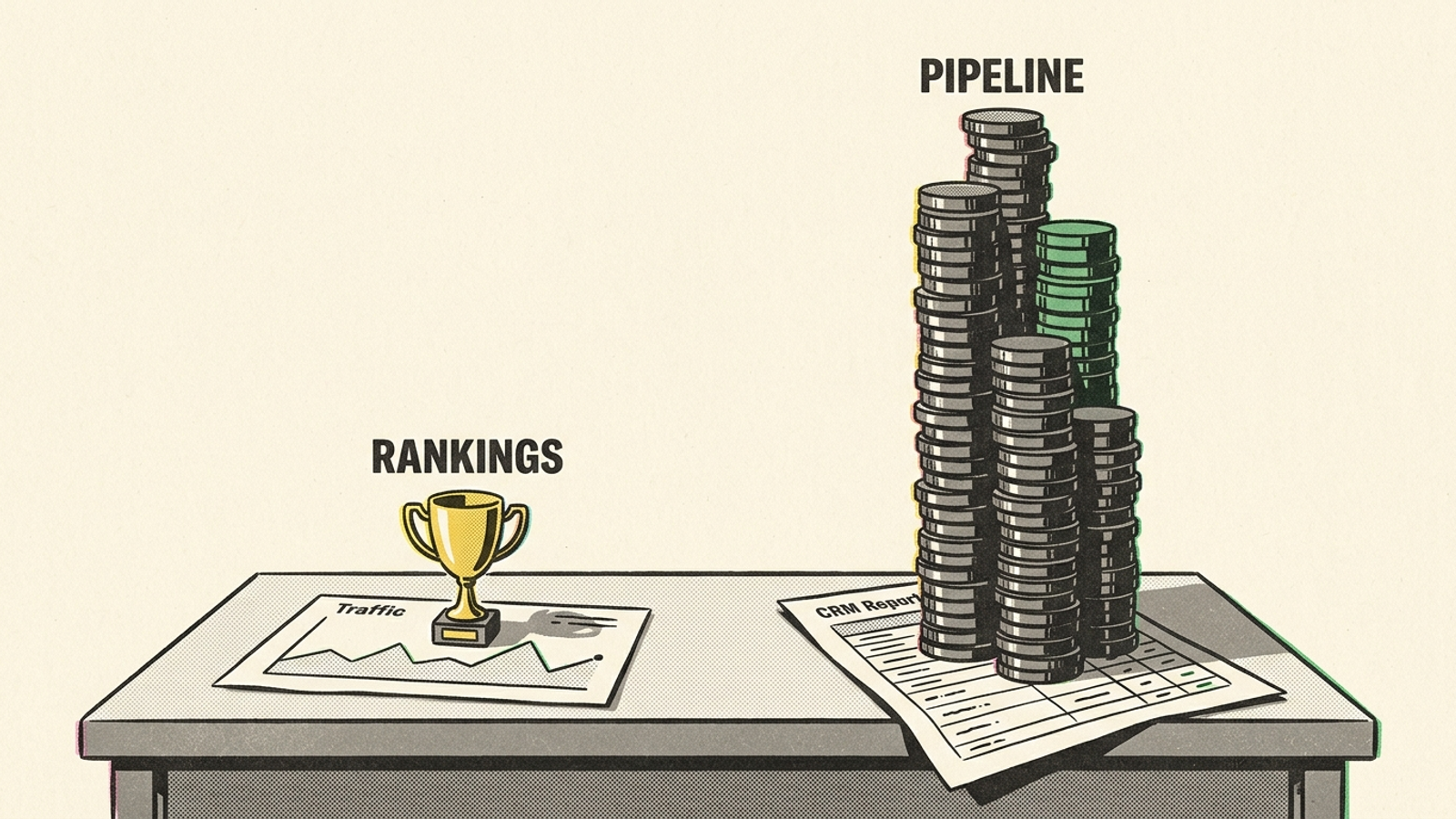
I learned this watching my own reports. Rankings are easy to move if you pick the right keywords. Traffic can follow if you publish enough. Neither pays your payroll. One agency study of pay-for-performance SEO found that vendors under payment pressure default to low-competition, zero-volume long-tail keywords to trigger payment. The result is ranking graphs without traffic or revenue (Victorious teardown). A conventional retainer can reward the same behavior without the payment trigger: activity gets recorded whether or not the changes shipped to your site create pipeline.
That does not mean you should throw away rankings, traffic, or citations. They tell you whether something happened upstream. But an upstream metric is a diagnostic, not the destination. If the report cannot connect the work to qualified opportunities, you are left interpreting a graph while someone else invoices you for explaining it.
Pure pay-for-results creates its own bad incentives
In Google Ads, I can tell you what a click cost yesterday and what it produced. Organic and AI search do not give you that neat daily accounting. Attribution can lag three to six months, which is why only about 15% of providers offer true pay-for-performance and the careful ones pair it with a base retainer (pay-for-performance roundup). Citations flip when models update. Rankings move when Google ships an update nobody warned you about. A vendor who promises to get paid only when you rank is either naive or planning to pick keywords you could rank for by accident.
The second trap arrives when you ask to pay per lead and the vendor says yes too fast. Now the incentive is to define lead as broadly as possible. You get billed for tire-kickers and non-buyers; some providers even resell the same non-exclusive leads to your competitors (zero-risk lead model teardown). I used to tell clients pay per lead aligned us. I was wrong. It aligned us toward volume, and volume is cheap when you do not have to close anything.
So do not ask for a magic contract where the vendor bears every risk you cannot measure. Ask for one where you can see the work, leave if it stalls, and judge progress against qualified pipeline. That is a harder deal to dress up with a ranking graph.
Four ways to make the retainer answer for itself
Forget the fantasy where you pay nothing until page one. Nobody controls Google or ChatGPT. Serious AEO retainers in 2026 run $3k to $15k a month, with entry programs at $1k to $3.5k and enterprise above $15k. Each extra AI engine adds 20 to 40% cost. If someone offers you all eight engines for $800 with no base fee, I would ask what, exactly, they plan to do.
You do not need a theatrical guarantee. You need terms that put the vendor’s margin and reputation at risk every month, in writing. These four provisions do that without paying people to chase junk rankings or junk leads.

1. An exit after setup, not a 12-month hostage deal
You do not need a 12-month lock-in to do good SEO. You need about three months to set a baseline, ship the first fixes, and see whether the vendor actually ships. After that, rolling monthly is the honest structure. A 12-month contract with no performance clause lets an agency underperform for a year and still invoice; a reasonable pattern is a three- to six-month initial SEO term followed by month-to-month work.
Read the buried lines before you celebrate the headline term: auto-renewal, notice period, kill fees, and who owns the accounts and content when you leave. An exit clause is worth little if the material you paid for stays behind. If the vendor needs a year of your money guaranteed before doing a week of work, that risk has been priced into your contract.
2. A fee that does not rise just because your spend does
Percentage-of-spend made a twisted kind of sense when humans adjusted bids by hand. It makes less sense when machines do the adjusting, and your content does not automatically cost ten times more because spend rises from $20k to $200k. I have written about how percentage fees and retainers misalign incentives before. The same question belongs in an organic and AI search conversation: what new work are you buying when the fee goes up?
A flat fee decoupled from spend is skin in the game in reverse. The vendor makes the same whether you scale or stall, so retaining you depends on moving your pipeline. Ask what changes the fee, and why. If the answer is simply that your business grew, the pricing rewards your growth before it proves the vendor’s contribution.
3. A record of changes, not a deck about effort
Ask to see last month’s work log before you sign. Not the deck. The log. A vendor doing real SEO and AI search work should be able to show you pages published, technical fixes shipped, citations built, and what moved after each one, with dates. A vendor selling hours can give you a summary of effort and a graph of impressions instead. Those are not the same thing.
One founder checklist puts it plainly: ask what will be done by month three, with deliverables, and whether you get dashboard access or summary-only reporting (questions to ask before hiring). Summary-only reporting asks you to pay for motion you cannot verify. A dated log gives you something specific to inspect and a basis for asking why a change was made.
I keep a rule from my agency years: if I cannot point to the exact change and the reason behind it, I cannot expect you to take my word for the work. Logged execution matters more than a performance slogan. It also makes the cheap version of skin in the game harder to hide. An agency under payment pressure can buy links from farms and PBNs to force a ranking; one UK pricing roundup puts the resulting cleanup at £5k to £50k (pay-for-performance risks). If URLs and reasons appear in the log, you have a chance to spot that risk before it becomes your problem.
4. Pipeline reporting, with citations in their proper place
Here is the test I run on a monthly deck: find the first number tied to money. If page three still talks about impressions, average position, and AI mention counts, the vendor is leading with what is easy to report, not what you need to know. In a survey of 1,000 organizations, revenue scored 10 out of 10 as the top SEO metric; pipeline scored 8, qualified leads and AI citations scored 7 each, and rankings scored 6 (NP Digital via Neil Patel). Put the report in that order. Pipeline first, citations as evidence of what may be working.
That does not require pretending every organic visit has a clean path to closed-won revenue. It requires the vendor to agree on what qualified means, tie its reporting to your CRM, and show the gap when the link is not yet clear. Otherwise, you get a tidy visibility report and have to do the uncomfortable part yourself: work out whether any of it reached a buyer. If the vendor wants credit for visibility, it should also be willing to discuss what that visibility produced.
That is why I look at what groas puts in writing before anything else: a flat fee, month-to-month after setup, every change logged with its reason, and weekly reporting tied to sales and visibility targets. It is a better alternative to paying for periodic decks and a fee that climbs with spend. Put your current finalist beside that structure and ask them to match the reporting line for line. You will learn more from the answer than from another presentation about partnership.
When this letter is not for you
I am not telling you every founder should buy the same contract. If you need 40 pages of content a month to feed an enterprise machine, or your procurement team requires a 12-month fixed vendor for compliance, keep the structure you can actually use. Month-to-month terms punish slow approvers as much as they pressure vendors. If your legal team takes three weeks to approve a page, you may pay for speed you refuse to use.
And if you are in the UK hunting a ranked list of top performance-based search firms, I would skip the list. I get asked who works on performance rather than a retainer. Pure performance for organic and AI search is rare for the reasons above, and a headline promise can conceal payment for junk leads or zero-volume rankings. Ask the shorter question instead: will this company put its work and reporting against qualified pipeline, not just leads? Then look for the four proofs, rather than the word performance in the headline.
Bring these ten questions to the signing call
You do not need to win an argument with a salesperson. You need answers you can compare with the contract. Take this list to every vendor on your shortlist, groas included; I have also written more on performance-based deals and contract clauses that cost businesses thousands if you want backup. If a vendor dodges two questions, end the meeting and read the agreement again before signing.
- What exactly ships by month three, with dates and URLs? No deliverables list, no signature.
- Can you show me last month’s change log for a real client, with reasons? Redacted names are fine; a summary deck is not a log.
- How will you report qualified pipeline from organic and AI search against our CRM? Rankings and mentions are diagnostics.
- Is your fee flat and decoupled from our spend? If it rises, ask what additional work you get.
- What happens after the initial term? Get the rolling-monthly terms and notice period in writing.
- How do you define a qualified lead, and do you get paid on raw form fills? Broad definitions reward tire-kickers.
- How do you diagnose rankings without traffic or pipeline? Listen for intent and volume, not just more content.
- Where do links and citations come from? Ask for examples, not a promise of vague outreach.
- What is your AI Overview and AEO process per page: crawl, answer block, structure, re-check? They should be able to describe the work.
- Who owns the accounts, content, and tracking on exit, and do we keep dashboard access throughout? This is the one founders skip. Without it, you leave with PDFs while the vendor keeps what produced value; rebuilding can mean another setup fee and three lost months.
If they tell you no other client asks these questions, believe them. Most founders sign first and ask in month four, when the deck arrives. You get to ask in week zero, when the answers still cost them something.
Yours, someone who used to bill by the hour.